
Executive review
In Supply Chain Planning, a decision can be well informed and still come too late. Planning teams work with information that is often incomplete while the operating context continues to evolve, which means the window in which a decision remains relevant can become shorter.
Agentic AI can help reduce part of the work required to move from a planning signal to a decision. Unlike a dashboard that surfaces information or a chatbot that helps users access or summarize it, an agent works towards an objective using relevant data, context and tools. It can investigate a situation, assess possible responses and support the work that happens before a planner is ready to decide.
The short answer
For Agentic AI to help shorten time-to-decision in Supply Chain Planning:
- Treat timing as part of decision quality. A sound decision still needs to be made while the organization can act on it.
- Look beyond the formal planning stages. Investigation, synthesis and coordination between those stages all contribute to time-to-decision.
- Use agents to progress towards an objective, not simply surface information. They can investigate causes, prepare scenarios and help structure the path towards a decision.
- Keep the business decision human. The planner remains accountable for interpreting the analysis and validating the final choice.
1. Timing is part of decision quality
A good planning decision needs to be based on facts, aligned across the relevant stakeholders and executable. It also needs to be made at the right time.
Planning decisions are contextual. A decision that makes sense under one set of conditions may no longer be appropriate once those conditions change. In other words, every decision has a relevance window: a period during which it remains appropriate to the context in which it was made.
Permanent uncertainty makes that challenge more pronounced because planners are increasingly required to decide while the available information is still incomplete and evolving. At the same time, the period during which a decision remains relevant becomes narrower.
The result is less certainty and a shorter decision relevance window, meaning less time to make the final decision count.
That does not mean choosing speed over rigorous analysis. We believe the objective should be to improve decision velocity without compromising decision quality, so that the rigor of the planning activities and the speed of the overall decision flow progress together.
2. Much of time-to-decision sits around the formal planning stages
Processes such as S&OP help make the distinction clear.
Demand Review, Supply Review, consensus, Pre-S&OP and executive decision-making all contribute to the quality of the final decision. But the speed of the overall process also depends on the work taking place between these stages.
Information has to be reviewed, exceptions investigated, possible causes understood and scenarios prepared and compared. Teams also need to coordinate before a decision is ready for validation.
This surrounding work represents an important part of time-to-decision. For us, it is also one of the clearest areas where Agentic AI can play a meaningful role: reducing some of the time required for investigation, synthesis and coordination before a person is ready to decide.
3. An agent does more than surface information
A dashboard can highlight that a problem exists. A chatbot can help users access or summarize the information available.
An agent works differently because it progresses towards an objective by using relevant data, context and tools.
A projected stockout illustrates that distinction. Identifying the shortage is only the starting point. The planner still needs to understand why it is happening, assess possible responses and evaluate their consequences before deciding what to do.
An agent can support several parts of that journey, including investigating potential causes and preparing and comparing possible scenarios.
4. Where Agentic AI can support the decision flow
Commercial forecast alignment and projected stockout response show two different ways this can work in practice.
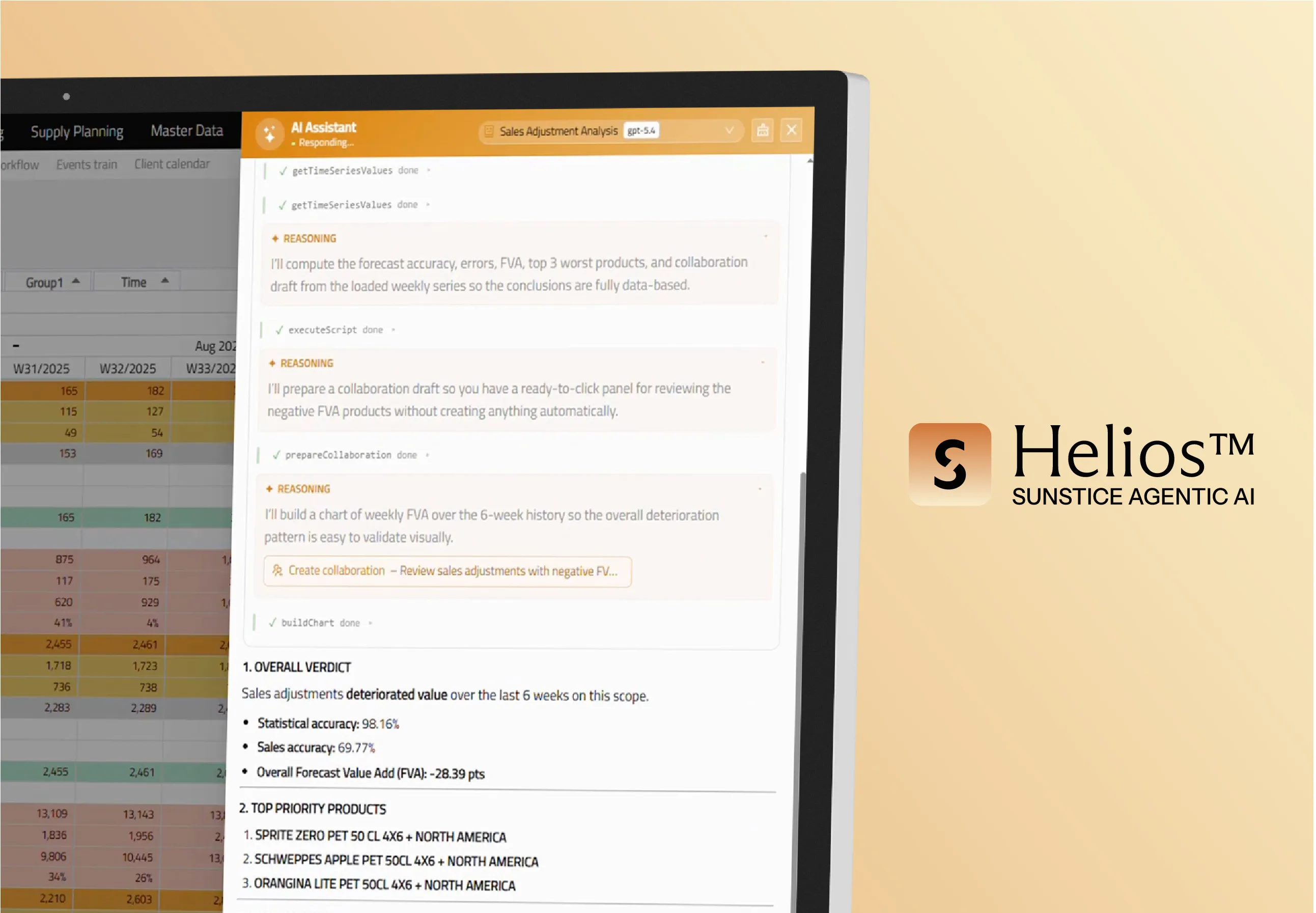
In forecast alignment, the objective is to identify where Sales and Planning need to discuss forecast adjustments. In a projected stockout situation, the work moves from understanding the issue towards investigating possible causes and comparing response scenarios.
In both cases, the agent supports part of the journey towards the decision rather than replacing the decision itself.
Agentic AI can support several stages of that journey:
- Signal: The starting point is identifying the exception or planning issue that requires attention. The agent can surface the issue alongside the information relevant to it.
- Investigation: Once the issue is identified, possible causes need to be understood. The agent can investigate them using the relevant data, context and tools.
- Evaluation: Potential responses then need to be prepared and compared. The agent can help build scenarios and evaluate their consequences before a choice is made.
- Alignment: Some decisions require discussion across teams before they can move forward. The agent can bring relevant information together to support that coordination.
- Decision: The final business choice remains with the planner, who interprets the analysis in context and validates what should happen next.
5. The business decision remains human
In commercial forecast alignment, the agent does not decide whether Sales or Planning is right. It identifies where alignment is needed.
In a projected stockout situation, it can support the analysis and scenario comparison before the planner interprets the recommendation within the broader business context and validates the final choice.
As Skander Beji puts it:
“The business decision remains human.”
The planner remains accountable, whether by validating what the agent proposes or by defining the rules and guardrails within which it operates.
We see this as an important principle of Agentic AI in planning: accelerating parts of the decision flow should not mean removing judgment, control or accountability.
For more on Sunstice's approach to combining responsiveness with structure and governance, see Structured Agility™.
Where is your time-to-decision really spent?
Improving planning performance is not only about producing better analysis. It also requires understanding where time is consumed before a decision can be made.
For Supply Chain leaders, one question is particularly useful:
How much of your current time-to-decision is spent making the decision, and how much is spent getting everything ready to make it?
The distinction can help identify where Agentic AI has a meaningful role to play.






































.webp)





.webp)

.webp)
.webp)
.webp)
.webp)